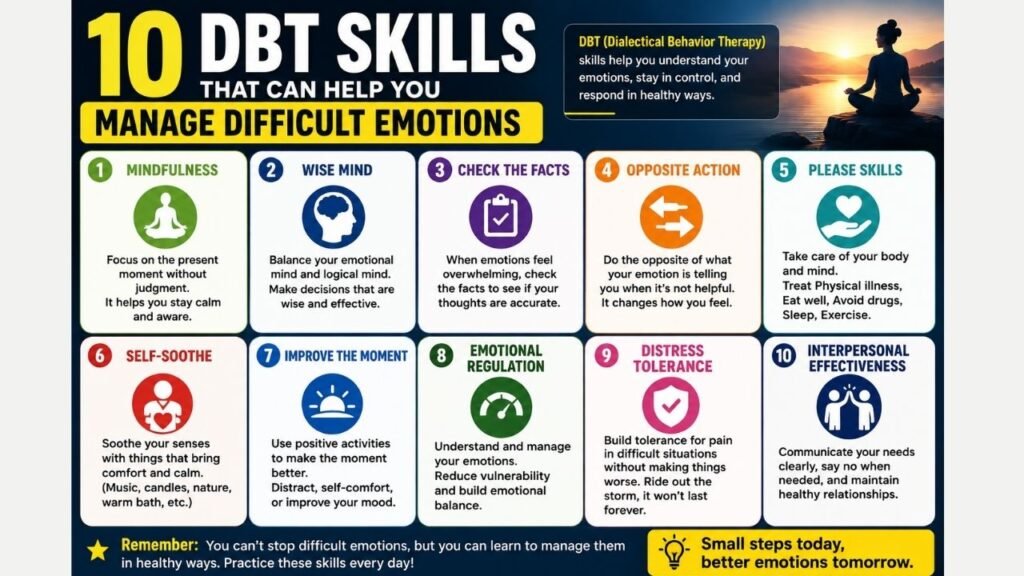
Strong emotions can make everyday life feel much harder. Anger, fear, sadness, stress, and worry can sometimes become so intense that it is difficult to think clearly or know what to do next.
Dialectical Behavior Therapy, or DBT, teaches simple skills that can help people handle strong emotions, deal with stressful moments, and respond instead of reacting. You do not need to use every skill at once. The goal is to find a few skills that work well for you and practice them regularly.
1. Stop and Give Yourself a Moment
When emotions become very strong, the first step can be to stop before doing anything.
This does not mean ignoring the problem. It simply gives you a little time to calm down before you say something, send a message, or make a decision you may regret later.
Try taking a short pause and telling yourself, “I do not have to solve this right now.”
That small break can give your mind time to catch up with what you are feeling.
2. Take Slow, Deep Breaths
Breathing is one of the easiest skills to use when stress starts building.
Try breathing in slowly and then breathing out slowly. Pay more attention to the longer, gentle exhale rather than trying to force yourself to take very deep breaths.
You can repeat this for a few minutes while sitting somewhere comfortable.
The goal is not to make the emotion disappear. It is to give your body a chance to settle down so you can think more clearly.
3. Use the STOP Skill
The DBT STOP skill can be useful when you feel like reacting immediately.
STOP stands for:
- Stop what you are doing.
- Take a step back from the situation.
- Observe what is happening inside and around you.
- Proceed carefully instead of reacting automatically.
For example, if someone sends you an angry message, you do not have to answer right away. Stop, notice your reaction, and decide what response makes sense.
4. Notice What You Are Feeling
Sometimes an emotion feels overwhelming because it is hard to understand what is actually happening.
Try putting a simple name to the feeling. You might be angry, disappointed, worried, embarrassed, lonely, or frustrated.
Then notice where you feel it in your body. Maybe your heart is beating faster, your shoulders are tight, or your stomach feels uncomfortable.
Naming the emotion does not make the problem disappear, but it can make the situation easier to understand.
5. Check the Facts
Strong emotions can sometimes make a situation look worse than it really is.
DBT teaches a skill called checking the facts. The idea is to separate what you know from what you are assuming.
For example, if a friend does not reply to your message, you may immediately think they are angry with you. But the fact is only that they have not replied yet.
Ask yourself what you actually know and what you are guessing.
This can help reduce unnecessary worry and prevent quick reactions.
6. Use Opposite Action
Sometimes an emotion pushes you toward a reaction that may not help you.
Opposite action means doing something different from what the emotion is telling you to do, when that emotion does not fit the facts or acting on it would make things worse.
For example, fear may tell you to avoid something that is safe and important. Instead of completely avoiding it, you might take one small step toward it.
The goal is not to ignore your feelings. It is to choose an action that helps rather than one that makes the problem bigger.
7. Practice Self-Soothing
When emotions are painful, simple comforting activities can help you get through the moment.
You can use your senses to create a calmer environment. Listen to quiet music, take a warm shower, sit outside, smell something pleasant, or hold a comfortable object.
These activities do not fix the reason you are upset. They can simply make the emotion easier to handle while you give yourself time to recover.
8. Try the TIPP Skill
TIPP is a DBT distress-tolerance skill designed for moments when emotions feel extremely intense. It focuses on quickly changing your body’s physical response to stress.
TIPP includes changing body temperature, brief intense exercise, paced breathing, and muscle relaxation.
For example, you can try a short period of safe physical activity followed by slow breathing and relaxing your muscles.
If you have a medical condition or physical limitation, choose only activities that are safe for you.
9. Practice Mindfulness
Mindfulness means paying attention to what is happening right now instead of getting completely pulled into thoughts about the past or future.
You can practice by focusing on your breathing, the sounds around you, or what you can see and feel.
When your mind wanders, gently bring your attention back to the present.
You do not have to clear your mind completely. Mindfulness is about noticing what is happening without immediately judging or reacting to it.
10. Build Positive Experiences
Managing difficult emotions is not only about dealing with bad moments. DBT also encourages people to build more positive experiences into everyday life.
Spend time doing things that give you a sense of enjoyment, connection, or accomplishment. This could be spending time with someone you trust, working on a hobby, taking a walk, learning something new, or finishing a small task. Small positive experiences may not change your life overnight. But regularly making space for them can help create a healthier emotional balance.
How to Start Using DBT Skills
You do not need to learn all 10 skills at the same time. Start with one or two that feel simple enough to practice.
For example, you could practice slow breathing when you are calm so it feels more familiar when you are stressed. You can also practice checking the facts whenever you notice yourself making quick assumptions.
With regular practice, these skills can become easier to remember during difficult moments.
When Extra Support May Be Helpful
DBT skills can be useful tools, but they are not a replacement for professional care when someone is dealing with serious or ongoing emotional problems.
If strong emotions are regularly affecting your relationships, work, school, sleep, or ability to manage daily life, talking with a qualified mental health professional can be a helpful next step.
A trained therapist can also teach DBT skills in greater depth and help you choose strategies that fit your situation.
Difficult emotions are a normal part of life, but you do not have to react to every emotion immediately. DBT offers practical skills that can create a little space between what you feel and what you do next.
Stopping, breathing, checking the facts, practicing mindfulness, using opposite action, and finding healthy ways to soothe yourself can all help you handle challenging moments more effectively.
The key is practice. These skills usually become more useful when you learn and practice them during calmer times, rather than waiting until emotions are already at their strongest.